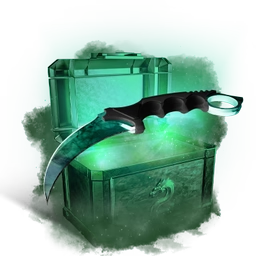
Few phenomena in modern gaming have captivated players quite like the weapon case system in Counter-Strike: Global Offensive (and its continuation in Counter-Strike 2). What started as a simple cosmetic update in 2013 has evolved into a multi-million-dollar virtual economy, a cultural touchstone, and a thrilling (albeit risky) pastime for millions of players.
Whether a player is a seasoned veteran with a thousand hours on Dust II or a newcomer curious about the hype, understanding how CS:GO cases work is essential. This comprehensive guide breaks down the mechanics, the odds, the economics, and the reality of opening cases.
What is a CS:GO Case?
A CS:GO case is a virtual container that holds weapon finishes (skins), gloves, or knives. To open a case, a player needs two things:
- The Case itself: Dropped randomly during gameplay, received as a weekly care package, or purchased from the Steam Community Market.
- A Key: Purchased directly from the in-game store for a flat rate of £2.50 GBP.
Once unlocked, the case spins through a visual roulette before landing on a random item. That item is then added directly to the player’s Steam Inventory, where it can be kept, traded, sold, or used in the game.
Types of Cases
Over a decade of updates, Valve has introduced dozens of cases. They generally fall into a few distinct categories:
- Active Drop Cases: Cases currently dropping in the weekly pool for active players.
- Rare/Discontinued Drop Cases: Older cases that no longer drop regularly in-game, making them rarer and often more expensive on the market.
- Commemorative/Major Cases: Cases dropped exclusively to viewers watching official Major tournaments via Steam. These do not require a key to open.
- Weapon Collection Cases: Associated with specific operations or maps, often featuring thematic designs.
Popular Case Categories at a Glance
| Case Type | Key Required? | Drop Status | Price Range (Approx.) |
|---|---|---|---|
| Active Duty Case | Yes (£2.50) | Common | £0.03 – £0.50 |
| Discontinued Case | Yes (£2.50) | Rare (Post-game drop) | £1.00 – £100.00+ |
| Major Souvenir Package | No | Event-exclusive | £1.00 – £50.00+ |
| Operation Case | Yes (£2.50) | Discontinued | £5.00 – £40.00+ |
The Mathematics of Opening Cases: Understanding the Odds
Before diving into case opening, one must understand the probabilities. Valve is transparent about the drop rates, which are baked into the code and regulated in certain regions.
When a player opens a standard case, the statistical breakdown of pulling a specific wear tier is roughly as follows:
- Mil-Spec (Blue): ~79.92%
- Restricted (Purple): ~15.98%
- Classified (Pink): ~3.2%
- Covert (Red): ~0.64%
- Special Item (Knife / Gloves): ~0.26%
Float Values and Conditions
Beyond just getting a rare skin, the item’s condition (Wear Rating) drastically affects its value. The wear categories are:
- Factory New (FN)
- Minimal Wear (MW)
- Field-Tested (FT)
- Well-Worn (WW)
- Battle-Scarred (BS)
Additionally, there is a very slim chance (roughly 1 in 10 inside the 0.26% knife drop rate) that the item will feature StatTrak™, a physical counter built onto the weapon that tracks confirmed kills.
The Virtual Economy: Why Cases Matter
The CS:GO case system is essentially a digital stock market. Because items have real-world monetary value via the Steam Wallet and third-party marketplaces, cases behave like financial assets.
- Supply and Demand: As the player base grows, the supply of older cases decreases because they are continuously opened and destroyed. This drives up the price of rare cases.
- Investment Culture: Many players treat cases as long-term investments. Buying hundreds of a specific case and holding them for years has yielded massive returns for some savvy collectors.
- Trade-Up Contracts: Players can trade in ten skins of the same wear tier for one skin of the next higher tier, adding utility to lower-tier items pulled from cases.
Pros and Cons of Opening Cases
While the rush of seeing a gold item flash on the screen is unmatched, opening cases is, fundamentally, a form of digital gambling.
Pros
- The Thrill: The excitement of the animation and the potential for a high-tier reward.
- Supporting the Game: Case sales help fund massive prize pools for professional esports tournaments.
- Liquidity: Skins can easily be sold on the Steam Marketplace for wallet funds to buy other games.
Cons
- Negative Expected Value (EV): Statistically, the average return on investment for opening a case is well below the £2.50 cost of the key. Most of the time, players pull items worth only a few cents.
- Financial Risk: It is very easy to spend significant amounts of money chasing losses.
Frequently Asked Questions (FAQ)
1. Are CS:GO cases still available in Counter-Strike 2?
Yes. All existing CS:GO weapon cases, skins, and inventories transferred seamlessly over to Counter-Strike 2. Cases function the exact same way in the updated engine.
2. Can I make a profit by opening cases?
Statistically, no. The vast majority of cases opened result in items worth significantly less than the £2.50 key required to open them. If your goal is to make a profit, buying specific skins directly from the marketplace is always safer than opening cases.
3. What is the rarest item you can get from a case?
Knives and gloves are the rarest standard drops (approx. 0.26% chance). Within that category, specific patterns (like Blue Gems for Case Hardened knives) or extremely low float values for rare knives (like the Factory New Crimson Web or Sapphire/Ruby Doppler finishes) can be worth thousands, sometimes tens of thousands, of dollars.
4. Do I need to play the game to get cases?
You do not need to grind matches actively, but you do need to earn your weekly care package by gaining XP on official Valve servers. Alternatively, you can simply purchase cases directly from the Steam Community Market without playing.
5. Are case openings rigged?
No. The odds are fixed mathematically by Valve, and the outcome is determined the exact second the key is used on the server side.
CS:GO cases are a fascinating intersection of gaming, probability, and economics. They add an extra layer of excitement to the Counter-Strike ecosystem, allowing players to customize their arsenals with unique and stunning artwork. However, approach them with caution: treat case openings as entertainment with a cost, rather than a get-rich-quick scheme, and you’ll enjoy the experience much more responsibly.
Find the perfect CS2 skin with insights into each CS2 Cases, including rarity tiers, weapon finishes, and collection highlights.